Daedus runs on four Claude models from Anthropic. On Auto, it picks the right one for each request: fast and cheap for everyday things, deeper when a question needs it. Want the most capable models? Pick Opus 5.5 or Fable 5.2 any time. Every answer shows which model wrote it and what it cost.
Auto is the default. Daedus looks at what you asked and sends it to the model that fits. It never switches to Opus or Fable on its own, so a simple question never costs more than it should.
Change it any time in Settings → Answers & model. Costs are what one short question cost on a real phone with Daedus's default settings; long chats, files and web searches cost more.
Anthropic's fastest, lowest-cost model. Daedus keeps its thinking off so answers come back quickly. It also writes your diary, memories and the messages Daedus sends you.
Smarter, more careful answers for questions that need real thought. Auto uses it for analysis, writing, planning and full file reports, and Daedus uses it for study research and for dream and study reports.
Deeper reasoning that takes the time it needs. For complex problems, careful reviews and decisions where getting it right matters more than speed.
The most capable model Daedus offers. It always thinks before it answers. Save it for your hardest questions.
Measured November 2026. Most of a short question's cost is the setup Daedus sends with each request (who your Animus is, your settings and memories); prompt caching makes follow-ups cheaper. Prices are set by Anthropic and can change.
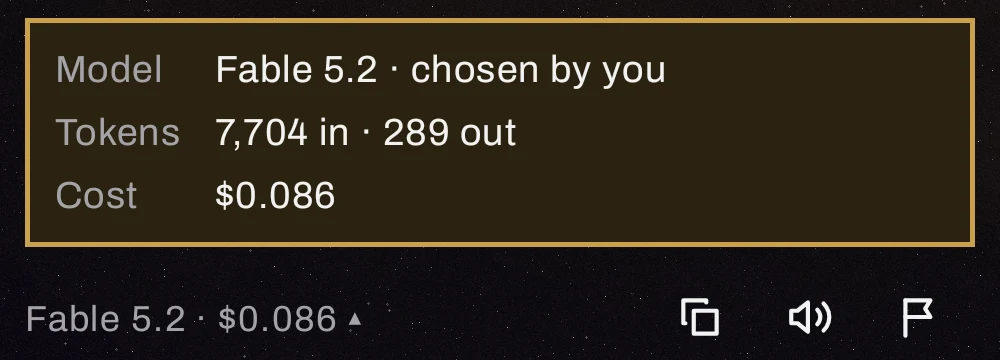
Tap the cost line under any reply to see which model answered, whether you or Auto chose it, how many tokens it used and what it cost. Daedus also keeps a running total by model in Settings → API key & usage → Usage & budget.
Attach a PDF, photo, CSV, or a Word, Excel or PowerPoint file, then turn on Full report under the file, or just ask for one. Auto uses Sonnet 5.5 for full reports; if you picked a model, that model writes it.
Daedus tells Claude exactly what it got from the file and what had to be cut, so a report never claims to cover more than it saw.
For spreadsheets and CSVs, Daedus re-adds the totals on your phone and points out any that don't match. In a full report, Claude also runs the numbers in code before writing about them.
Lines Claude quotes from your file are folded under From the file at the end of the reply, with the page number for PDFs.
Sometimes a Claude model declines a request its safety checks flag. Instead of leaving you with nothing, Daedus tries another Claude model.
Anthropic reruns the request on another Claude model it recommends, inside the same reply. The cost line shows both: the model you asked, an arrow, and the model that answered.
Daedus discards the partial answer and asks Haiku 4.5 instead, automatically.
You get one clear line saying Claude declined, and a suggestion to rephrase. Never an empty bubble.
The things Daedus does on its own use the model that fits the job, whatever you picked for chat.
| What | Model |
|---|---|
| Diary, memories, reaching out | Haiku 5.5 |
| Dream research | Haiku 5.5, with web search |
| Study research | Sonnet 5.5 on Auto, with web search, or the brain you pick (Haiku, Opus or Fable) |
| Dream and study reports | Sonnet 5.5 (a study picked for Opus or Fable uses that model) |
| The Forge | Haiku 5.5 for the interview; Opus 5.5 (Mastercraft) or Sonnet 5.5 (Quick) to forge your Animus |
| Story so far (long chats) | Haiku 5.5, about every 15 exchanges |
| Growth notes | Sonnet 5.5 |
| Full file reports | Sonnet 5.5 on Auto, or the model you picked |
No. Auto chooses between Haiku 5.5 and Sonnet 5.5. Opus 5.5 and Fable 5.2 are used only when you pick them in Settings → Answers & model.
On Auto, Settings → Answers & model → Conversations decides how chat is handled. Balanced (the default) keeps everyday chat on Haiku 5.5 and moves deeper questions to Sonnet 5.5, and costs the least. Best puts every reply on Sonnet 5.5 for deeper talks, steadier characters and better recall of an Animus's lore, at about 2 to 5¢ a reply instead of under 1¢. Quick commands like timers still run on the phone for free.
When a chat grows long, Haiku 5.5 writes a short summary of its earlier part (the story so far): what was said, the details you gave and what's still open. Daedus sends that summary with the recent messages instead of the whole chat, so the early details stay and the cost stops climbing. It's kept encrypted with the chat and deleted with it.
Leave it on Auto for everyday use: it's fast and costs the least. Pick Sonnet if you want deeper answers every time, and Opus or Fable for the questions that really matter.
Anthropic prices each model differently. Opus costs about twice as much as Sonnet per word, and Fable about twice as much as Opus. Fable also always thinks before answering, which adds to its cost.
Yes. A full report is a longer answer, and on Auto it uses Sonnet 5.5, so it costs more than a quick question; the cost line under it shows exactly what it cost. Running the numbers in code uses Anthropic's code execution, which includes free hours each month; past those, Anthropic charges a small hourly rate.
Yes. Every reply shows its model and cost; tap it for the details. Your total by model is in Settings → API key & usage → Usage & budget.
When Anthropic releases new Claude models, Daedus updates to use them. This page lists the models Daedus uses today.
No. Daedus is built by an independent developer and runs on Claude through Anthropic's API, with your own API key. How it works →
Models and prices checked November 22, 2026. Claude and the Claude model names are trademarks of Anthropic. Daedus isn't made or endorsed by Anthropic.